
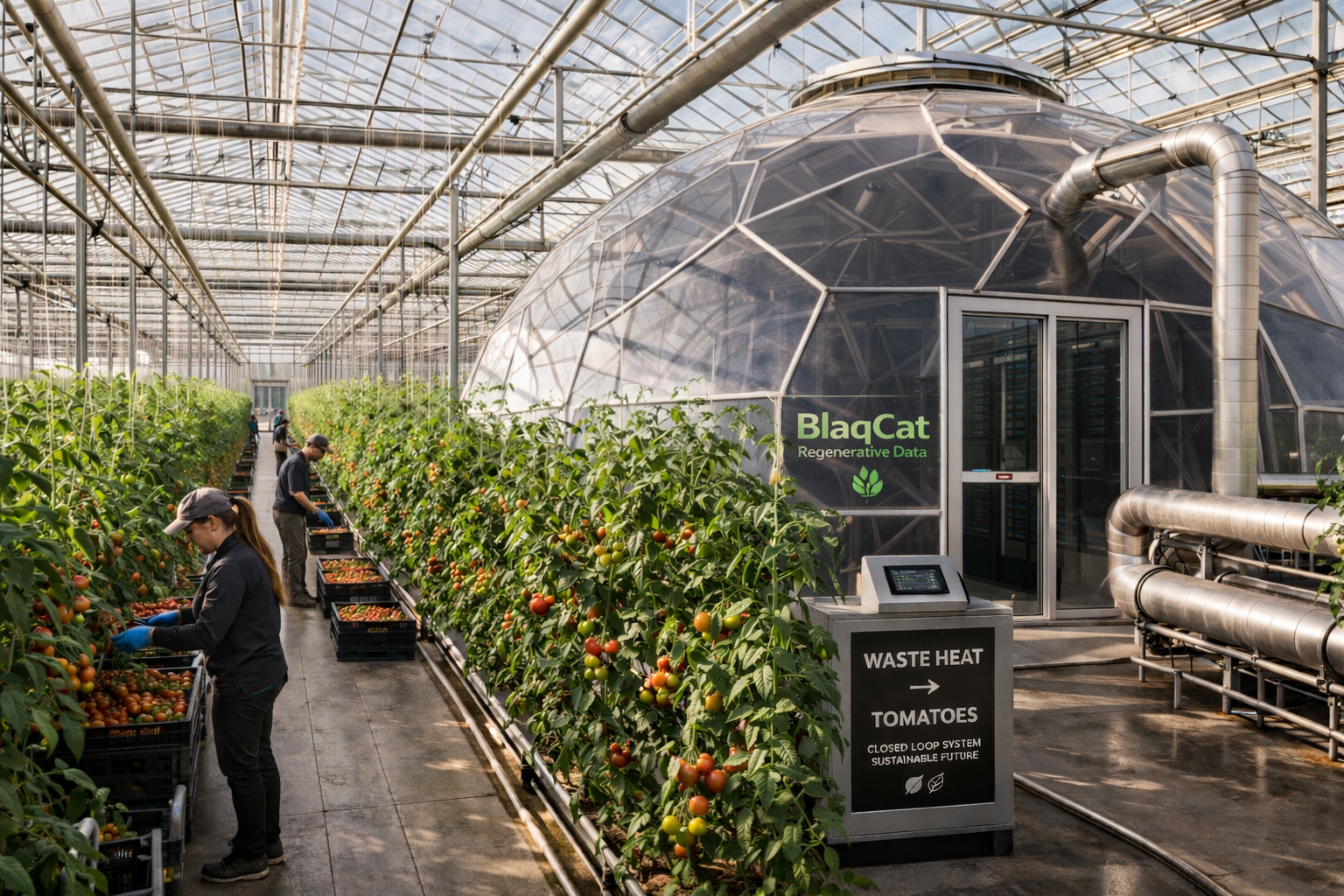
A data centre should leave a place better than it found it.
We didn't arrive at that as an outsider's idea. We built the industry's biggest facilities for years before we decided this was the part worth changing.
We've built the biggest. We chose to build differently.
Our team has worked for all the hyperscale data centre operators (Amazon, Vantage, Google) and delivered £500m of hyperscale data centre build. That model has its place: it powers the cloud at global scale. But we wanted to explore a different kind of compute, one that can happily run in the shadows, tapping into localised pockets of available energy, or bring its own power to a DC in a location you wouldn't expect.
Where we can combine both data sovereignty and food sovereignty under one roof. Where what we do matters.
So we went back to first principles of engineering. Instead of starting from a mechanical engineer's spec sheet, we asked what nature already does better: how a termite mound regulates its own temperature without a single fan. That question is the design's real north star, more than any single spec on the Dome page.
Infrastructure designed to belong.
Most data centres are judged on one thing: can they run the compute. We think that's the wrong bar. A site should be welcomed, not tolerated. An asset to the community around it, not a burden it puts up with.
Same compute, same uptime, same performance a tenant needs. What's different is what the building gives back once it's built.
Welcomed, not tolerated. An asset to community, not a burden.
Smaller, more modular data centres.
Hyperscale has its place: it powers the platforms the world relies on. We're choosing a different scale on purpose: smaller, modular facilities that can sit close to the people and places they serve, tapping into localised pockets of available energy or bringing their own power to locations you wouldn't expect.
Free heat
Only helps a neighbour if there's a neighbour close enough to reach.
Food sovereignty
Only makes sense grown near where it's eaten.
Data sovereignty
Only strengthens a place if it stays close to the people and businesses that rely on it, not living on the other side of the world.
Right-sized isn't a limitation we accepted. It's the design decision that makes the rest of this real.
We don't turn up with a blueprint. We turn up with a question.
What would this place actually benefit from? Every site is different, so every answer is.
Listen
Meet the place and the people who already know it before we propose anything.
Assess
Model what actually fits: heat for the building next door, food for the village, warmth for a wellness space, power back to the grid. Not every site wants or needs all of it.
Give back
Invest something into the community that belongs to it, not to us.
Same dome. Different gift, every time.
It looks simple. It isn't.
We spent two years out of view before showing this: CFD studies, engineering due diligence, and real investment, all in service of a dome that looks almost too simple to be new.
Our sister company, ServerGro™, holds patent-pending technology for storing and reusing water within a data centre's growing systems, giving a BlaqCat dome the potential to run on close to zero water.
None of it is an accident. It's what happens when the goal is to get this right before anyone else sees it: simple to look at, and, we think, genuinely different underneath.
Measured, not marketed.
Every project on this site carries an honest status (live, in build, contracted, or still ahead) and every figure we publish is labelled as a design target or a measured result, never blurred together. The full picture (water, power, heat, food, jobs, and how we test before anything is signed off) is on the Impact/ESG page.